Journal of Jewish Education (2026) 1: 155-165
Voices From the Field:
Building Children’s Jewish Identity and Community in a Reggio-Inspired School
Allie Baylson and Miriam Kalmar
From the early childhood center’s (ECC) inception the values of progressive education, creative play-based experiences, and a strong Jewish identity have always been vital to our school. Our collective journey as a school over the past two decades has been punctuated by key opportunities that have helped to shift our thinking about our work while moving us closer to realizing the potential we see in ourselves and our community as a whole. These experiences have affected change both large and small, from drastic changes in the physical space of our early childhood center to thousands of nearly imperceptible shifts in perspective and practice. Cumulatively, they account for the root of our school’s persistent evolution and reflect our depth of reflection and introspection, our commitment to intentionality, and our unfailing pursuit to express our values.
As a school that has been studying the work being done by educators in Reggio Emilia for over 25 years, we often are struck by the myriad ways that the schools in Reggio-Emilia involve their city at large. As a small Jewish school in a very large city, with safety and security considerations, we have often wondered about how we can involve our community more with the work of the children. Through various projects over the last few years, the children showed us what community means to them and how to use our surroundings to involve and care for others. Community is such a strong and important part of Judaism. The children’s work reminded us how important it is to care for our community and how community is an essential part of helping young children develop their Jewish identity.
Our participation in the North American Reggio Emilia Alliance (NAREA) conference and Wonder of Learning exhibition marked an important moment in building our Jewish identity. We realized that we had reached a point where we could now educate and inspire other early childhood educators. We had always welcomed visitors to the ECC, but we were now stepping onto a larger stage as we reached out to educators from all around the country. The staff as a whole took on an active role in determining how best to represent our school not only as a Reggio-inspired school, but as Jewish school inside a synagogue.
When we began our Reggio journey, we were eager to learn first-hand from the exceptional educational system of Reggio Emilia, Italy, so we committed staff development resources to sending small groups of educators on international study groups. International study groups allow educators to visits schools in Reggio Emilia and meet with Italian educators to gain a deeper understanding of the Reggio Emilia approach. Staff impressions of Reggio Emilia were eye-opening, overwhelming, and positive as each group returned to the ECC with a new understanding of all the possibilities we could pursue in our classrooms.
We began to think about the aesthetics embedded in our everyday routines -- how can we set up our space to make it most inviting to the children? How can we provoke thought and creativity and innovation? Our classrooms became more homelike.
We were opened up to a new world of recycled and found materials and came back from Italy excited to see how we could use these materials in our own classrooms. We began asking more questions about the materials we choose to offer to children and why, understanding that each unique material has merit. With these new materials, we gained a new view of the children’s capability and learned to trust them to explore and create on their own while we took a step back and focused more on listening and observing. Every material we introduce to the children serves a specific purpose -- when do we give them pens and when do we offer them markers or pastels or clay or wire? Reggio helped to further reveal the innate possibilities that surround us and to see the quotidian aspects of our days in school as extraordinary opportunities.
Teachers began to see Reggio as a way of existing with the children, within their shared space, and within themselves. Reggio is not just an inspiration, but also an attitude. We decided to change the way we shared the contents of our day with the children and parents -- we shifted the way we wrote our daily journals. Rather than simply recounting the day to the parents, we wrote thoughtful missives sharing the meaning behind the children’s work, revealing the heart of the learning that we do together at the ECC.
In preparation for our visitors during the NAREA conference we looked first at our classrooms, our homes within our school building, to see which values were clearly embodied with an eye towards thinking about the story our space and our materials tell. What was Jewish about our physical environment? How are our values made visible in our spaces? What do our spaces say about us as a school? With these questions in mind, we decided to pay special attention to our entryway, how do people feel when they walk into our school?
To begin the evolution of our entryway we decided to first focus on the walls and bulletin boards. Did we even want bulletin boards or did we want an art installation? What did we want people to see the moment they walked into our space? As this is a common space used by the parents, children, teachers, and administration we began by creating an interest group. We had members of the administration as well as teachers, who were interested in transforming the space. We began our research by using inspiration that teachers had brought back from Reggio Emilia, “a place becomes a place when it is inhabited.” We first had to observe the space in use. To do this, teachers worked in pairs at various times of the day. They observed and documented through notes, sketches, sound recordings, and video footage. After collecting data for several weeks, the interest group got together to share their observations and documentation.
The group discovered that both the bulletin board and the space in the hallway were significant for parents, children, teachers, and caregivers. Both children and parents connected to the broader staff through images that were on the wall of the school staff. Many adults (including teachers) checked notices as they waited for the elevator. It was observed that caregivers form a community on the bench before pickup and parents of younger children will wait on the bench for older children to finish for the day. The morning was about getting to class while the afternoon was for conversation about the day between adults and children. We wondered if the children considered the hallway their space or if they saw it as something for the grown-ups. Our question was answered when a child found a mitten on the roof and decided he had to hang it in the hallway so he could find the owner. We were left with lots of questions and not so many answers on what to do. Is there a way for classes to represent themselves along with staff photos? How will we represent our Jewish identity in the space? Is there another way to look at the space as an area of learning? As we were pondering these questions a group of teachers went on a study tour to Reggio Emilia. While in Reggio the teachers spent time in its schools’ entryways and spoke with teachers and administration about the space and how it was used. They noticed the welcoming feeling, the image of the child and the rights of children, and the way the space was used by both teachers and children. They also looked at the entryways of museums, public spaces, tunnels, and hotels.
In Reggio the teachers took lots of photos, videos, and sound recordings. They spent time discussing how our hallway could be used. They had heard of soundscapes and decided we needed hallwayscapes, different mediums and materials used in the hallway. Inspired by what they saw in Reggio, teachers realized they wanted a space that was for discovery, inspiration, exploration, to be used by children and adults that would reflect our values. Bringing this information back to the group, teachers worked together to create a definition of hallwayscapes.
Hallwayscapes are intentionally created, multisensory experiences designed within our halls as an invitation to the entire school community to engage in shared learning through play. We recognize that learning does not begin or end at the doors of the classroom, but rather is the constant reality for young children throughout all of the spaces they inhabit.
Our first hallwayscape was introduced in March 2016. The teachers who went to Reggio brought back the sounds, sights, smells, and textures of their trip back to the community for exploration and reinterpretation. They placed signs in the hallway that said, “Take a moment to look around. Listen to all of your senses. What do you notice?”
Once the hallwayscapes were offered we noticed that families, teachers and caregivers began to slow down. They stopped, wondered, and began conversations about the environment. Hallwayscapes are multidimensional and interactional; they are not bulletin boards but interactive experiences. These experiences allowed the children to slow down and helped them thrive as they entered school leaving the city rush behind them. Hallwayscapes also allow for a sense of community. Classrooms, parents, caregivers, and even synagogue staff stopped and explored together in the hallways. We realized through the execution of hallwayscapes some of our core values are embodied: play, wonder, joy, community, collaboration, curiosity, discovery, inquiry (children and teachers as researchers), power of materials, and building relationships. Upon reflection though, we wonder, aren’t all of these values inherently Jewish? Do they need to be labeled in a “Jewish” way? The struggle between implicit vs. the explicit. We also realized that this entire process is reflective of our constant commitment to evolve as a school. We decided to continue hallwayscapes while enhancing a sense of Jewish community. We decided as a school that we will give children the opportunity to explore the sounds, sights, smells, and textures of the different Jewish holidays and Shabbat. The children will be able to explore and interpret their own meaning of what it means to be Jewish through these hands-on experiences. Our hope was that the children would bring these experiences to their classrooms and homes.
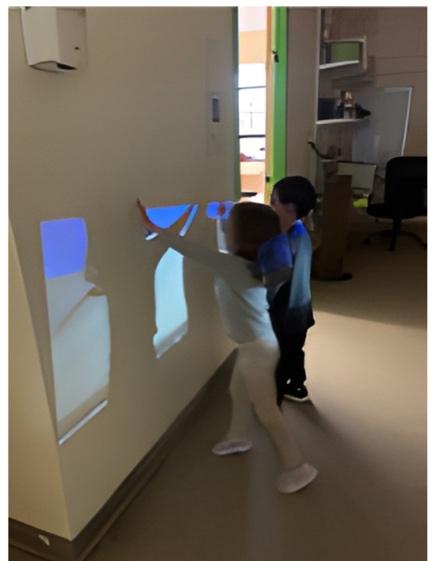
As we approached Passover, we began to think about how offering of the ordinary in a new context generates wonder. As we planned the Passover hallwayscape we thought about how the children at the ECC relate to Passover through the story. One teacher noticed that her class was specifically captivated by the environments portrayed in the Passover story, Egypt/the desert. That teacher put photos and videos together of her travels through deserts around the world and projected them in the hallway. Just a small addition of a video projection made families and children stop in their tracks and share what they noticed and initiate conversations about Passover.
In all of our hallwayscapes our goal was to engage our entire community in celebration commemorating our holidays and fostering our sense of Jewish pride and identity. The children began to see the hallway as a place of community gathering. Their understanding of the hallway as a special space in our school was apparent as the hallway became a launching point for a curriculum around caring for our community.
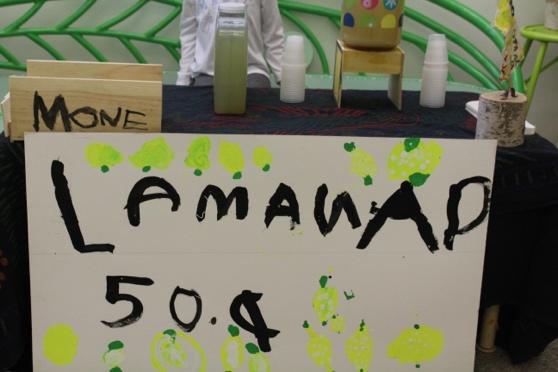
The children in one of the 4s/5s classes made lemonade. They decided, “since we made lemonade, we could make a lemonade stand in the hallway.” This sparked a conversation among the children about the physical characteristics of a lemonade stand. The children created a money box, shelf, flag, and umbrella for the stand.
The teachers then encouraged conversations among the children to fully hear all of their ideas and motivations around the lemonade stand. The children were eager to include everyone in the school, their families and other people who work in the synagogue. They wanted to use the money to help support the Men’s Shelter that was housed in the synagogue. As they explained, “If we kept the money, it wouldn’t be nice. We should give it to people who need it. It would be nicer to give to people without money.” “If people didn’t have money they would cry so we have to give it to them. We have to raise money.” “They need money so they don’t need a shelter anymore.” “They need challah for Shabbat.” They designed, wrote, delivered, and posted flyers publicizing the sale in our school’s hallway. They raised one hundred and eighty-four dollars for the Men’s Shelter.
Around the time of the lemonade stand our studio teacher, along with two classroom teachers, attended a weaving workshop for educators. They were excited to bring this craft to the children to offer a new language for exploration. In Reggio teachers are considered researchers as they work and learn alongside the children. We encourage teachers to bring their own interests and passions into the classroom. In the studio, the children began engaging in the art of weaving, learning the basics.
As soon as the children had their lemonade sale, they were eager to repeat the process and make more money for the shelter. The teachers challenged the children to do something different. The children came up with various things they could make and sell such as cookies, candy, slime, challah, and even their weavings. The teachers revisited the idea of selling weavings by asking the children what they can do with their weavings. “I can make a blanket, you have to weave for a long, long time.”, “We could weave a cover for our journey binders.”, “A cover for challah.”, “We could sell covers for challah.”, “Yeah, we sell stuff in this class.”
Before the children began creating challah covers the teachers began to research if there were “rules” for challah covers. The teachers and children began to research together. Researching alongside the children showed the children that everyone is always learning and discovering about the world around them. The children collected challah covers from all the classrooms to see if they were the same or different.
They discovered some had Hebrew letters while others didn’t, they were all different sizes, and made from different materials. The children began to question what made something a challah cover? Could they just use a piece of paper? They decided they needed to ask an expert and wrote a letter to Rabbi Sam.
Rabbi Sam visited the class to answer their questions “Do challah covers have to be furry?”, “Do challah covers have to have Hebrew?”, “Do challah covers have to be a certain size?” She explained to the friends, “When I got your questions, I did a little research because I didn’t know. You know what I found out? There are no rules around making challah covers but there are lots of customs.” The children explained to Rabbi Sam that they think their challah covers should be fuzzy, “to keep the challah cozy and soft.” Before leaving, she explained, “what you decide to do with your challah covers is going to be just right and what is meaningful to you.”
Once the children learned they could make their challah covers with fluff or without fluff and with or without Hebrew letters they began measuring the different challah covers to see how big they needed to make their weavings. They took a weaving a friend recently finished and placed it on top of our class challah. “It needs to be long enough. It is not good because it needs to be long enough to the bottom. It has to cover the whole challah so the challah doesn't dry out.”, “We need a big ginormous weaving, it will take eighty-eight minutes to weave a big one.”
The friends realized that while Shabbat is a time when Jewish people bless the candles, wine, and challah everyone has their own way of celebrating Shabbat, even Rabbis. As the children researched more about Shabbat customs, they began to wonder why challah even needed to be covered and why was it the last blessing we recited at our Shabbat celebrations. In Judaism we are encouraged to ask questions and we encourage the children to ask questions and wonder about various traditions. As educators it is our job to support their expressions of wonder. Rather than providing an answer we asked them to share their ideas, making space for interpretation and the magic of the unknown. Inquiry is the base for children to construct knowledge and the base for forming their Jewish identity.
The teachers asked the children why we cover challah when we celebrate Shabbat? The children shared various ideas: “So it is a surprise.”, “So it doesn’t get cold.”, “Because we are Jewish.”, “So no one knows it is challah. So the challah can be beautifuller.”, “Because you need to put your hand on the challah and you are not supposed to see the challah because then you may just eat it.”, “Because it looks pretty on the challah.”, “To keep the challah safe.”
With all the different reasons the children came up with they still weren't sure they knew why challah had to be covered. They decided they needed to ask, “a really smart guy”, “my mom or dad” or “God.” They wrote notes to their families, “Dear Mom, why do we cover challah?” What resulted were family discussions about Shabbat and challah. Parents kept telling us it made them think about their own traditions and made them do their own research. One parent responded, “This was a great question. According to tradition, in order for the challah not to be jealous or ashamed, it is covered as the wine is blessed and drunk first before the challah is blessed and eaten.”
After reading all the responses it was clear to us that the children connected with the challah and idea of what it feels like to be last. “We don’t want the challah to be jealous of the grape juice. Being last is actually good.” , “We can tell the challah it is good to be last.”, “Do you know why being last is actually good? Because maybe someone who is last will get a special thing that they actually want.”, “On Shabbat you are grateful for someone, and challah could still be grateful even if it goes last. Like how some people grow up and go bigger before you.” The idea of being last clearly resonated with the children. This is a concept that 4- and 5-year-olds often struggle with and leads to many class meetings about how we are all going to the same place and that it is okay to be the last friend in line.
When the children started weaving the challah covers, they realized they would need a lot of challah covers. “How much lemonade did we sell? We need that many.”, “My mom will buy 100.”, “There are 500 people in the building. So we need a lot.”, “It is kind of hard to weave. You have to go under, over, under, over but if you go the other way you will undo it.”
They soon realized that they would need help to create enough volume to sell at a stand, so they decided to outsource the work. The children created an instructional video and wrote a step-by-step guide to weaving so they could teach others how to weave.
They invited parents, grandparents and caregivers to weave in the studio in the mornings before school. They taught other teachers how to weave—asking the entire community to help.
They determined that they were now a challah cover company and needed a name and a logo for their business venture. After a class vote the children name their company Super Weavers: Superheroes who Weave Fast. Their name represents their love of weaving and their dramatic play games that often involve superheroes.
Just as they had with the lemonade stand the children advertised the sale to everyone. They even offered one of the Rabbis an advance sale as he would not be there the day of their challah cover stand. Their hard work paid off, and they collected more than five hundred dollars for the Men’s Shelter. They communicated with the men about what their needs were and shopped for some of their requests before delivering the gifts to the shelter.
Throughout the whole process the children thought of the members of their community and how they could help them. They had discussions about where to have the stand so everyone could come, how their profits could help the shelter, and how to make sure they were following the “rules” of Shabbat.
The children, through their work on this project, showed us how to authentically include the larger synagogue community. Their determination to include all of the people in their surroundings demonstrated to us how we can be an integral part of our larger community and show others the wealth of possibility that young children have to offer. Classes in our school continue to use the challah covers that were made by the 4s/5s in their own Shabbat celebrations sharing how the challah cover came to be a part of that class’s Shabbat traditions. Families have even returned to visit our school and share that they started celebrating Shabbat at home using the challah cover that their child made as it gave the children an investment and interest in various Jewish traditions and ritual objects.
The use of the hallway has continued to be an important part of our school. Around the Jewish holidays teachers volunteer to help set up a multi-sensory experience
for the community. It has included everything from plants in
the hallway, with a forest on the ceiling and animal sounds for
Tu B’Shevat to colored lights and streamers for Purim.
Classes use the hallway to share projects they have been working on and to display documentation. We are a Jewish Reggio-inspired school with passionate, dedicated teachers who are committed not only to the children and families they serve but to the field of Jewish early childhood education as well. Our school is a place where children, parents, and educators alike can learn and grow as human beings, where we learn to be comfortable with being uncomfortable, because we understand that that is the catalyst for growth and change.